Back to Index

Brando Ice Cream Shop

Madrid. 2021
In collaboration with SOLAR
Photography: Imagen Subliminal

Starting at the beginning of our century, after the pedestrianization of Fuencarral street, the Chueca neighborhood, located at the historic center of Madrid, undergoes a transformation led by the preponderance of corporate franchises that have displaced local producers and businesses.

The project seeks to reactivate a store through a new identity that proposes to incorporate not only a product made by hand, but also an architecture that avoids the use of materials typical of the world of retail, including trades that had been excluded from the sector.


COAM Emergente 2023 Award Mention
FAD Interiorismo 2023 Nominee
Building of the Year ArchDaily 2022 Nominee
Exhibited at La arquitectura de los arquitectos.
2nd Edition, COAM, Madrid 2023

The proposal is based on three fundamental premises: a reduced budget (just €275/m2), the development of a recognizable image (branding follows architecture) and a limited execution time (3 weeks).

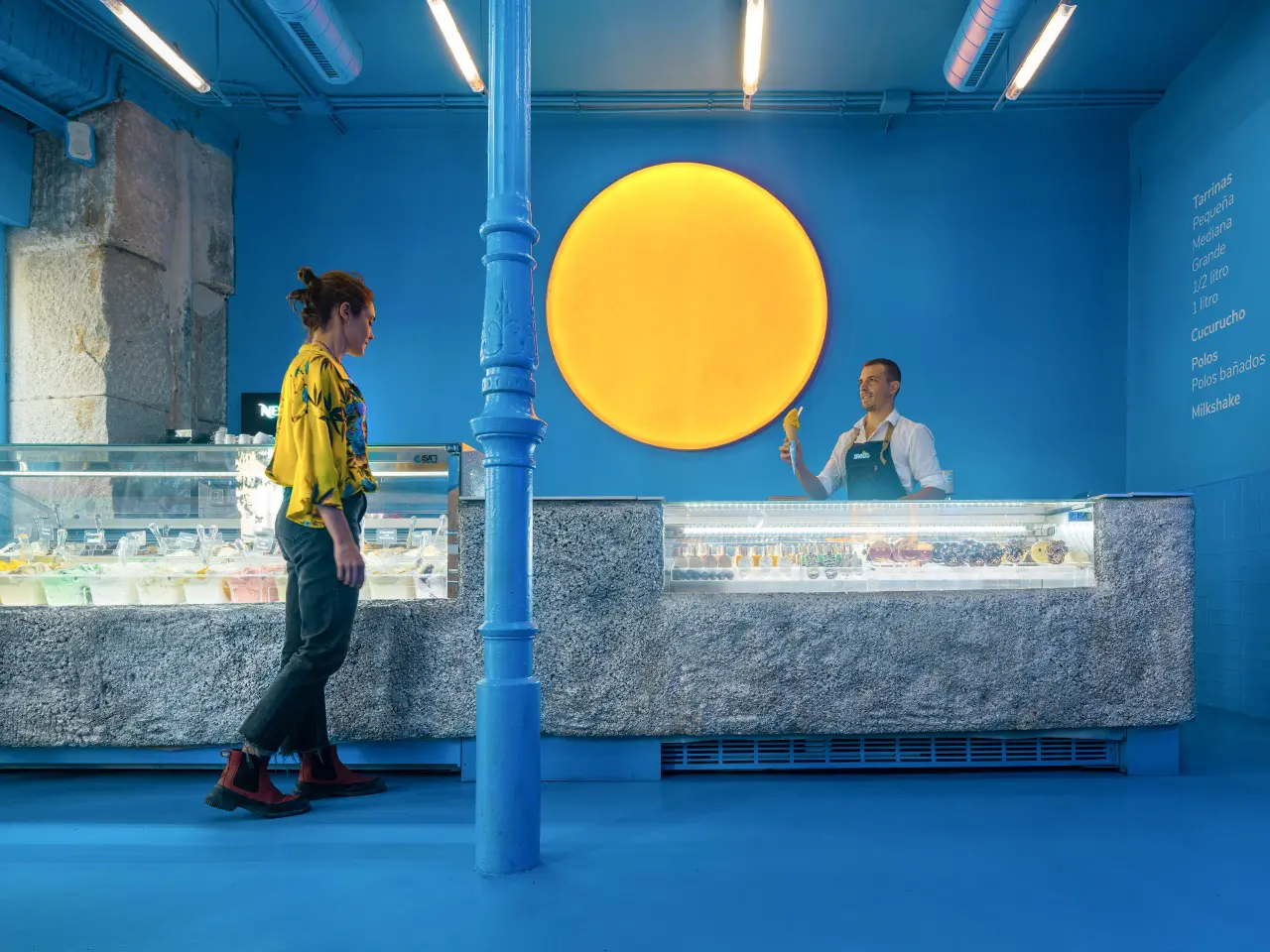
With these starting points, the creation of an artificial landscape is proposed where the perception of scale is blurred through the use of the color blue. This strategy responds to an economy of means in the form of an ecological manifesto, avoiding demolitions to minimize the generation of waste, while allowing the space to be unified, leaving the different historical layers of the premises visible and giving the business a recognizable identity. In addition, all the machines in the premises are second-hand, guaranteeing the financial sustainability of the business, but also the ecological one by reducing the carbon footprint associated with its production.

Brando

Ice Cream Shop
Madrid. 2021
In collaboration with SOLAR
Photography: Imagen Subliminal
COAM Emergente 2023 Award Mention
FAD Interiorismo 2023 Nominee
Building of the Year ArchDaily 2022 Nominee
Exhibited at La arquitectura de los arquitectos.
2nd Edition, COAM, Madrid 2023
Starting at the beginning of our century, after the pedestrianization of Fuencarral street, the Chueca neighborhood, located at the historic center of Madrid, undergoes a transformation led by the preponderance of corporate franchises that have displaced local producers and businesses.

The project seeks to reactivate a store through a new identity that proposes to incorporate not only a product made by hand, but also an architecture that avoids the use of materials typical of the world of retail, including trades that had been excluded from the sector.

The proposal is based on three fundamental premises: a reduced budget (just €275/m2), the development of a recognizable image (branding follows architecture) and a limited execution time (3 weeks).

With these starting points, the creation of an artificial landscape is proposed where the perception of scale is blurred through the use of the color blue. This strategy responds to an economy of means in the form of an ecological manifesto, avoiding demolitions to minimize the generation of waste, while allowing the space to be unified, leaving the different historical layers of the premises visible and giving the business a recognizable identity. In addition, all the machines in the premises are second-hand, guaranteeing the financial sustainability of the business, but also the ecological one by reducing the carbon footprint associated with its production.